My wife and I had been eating at a table that was too small for six people for about four years. I kept saying I would build a replacement. This summer I finally ran out of excuses, bought a stack of rough walnut, and cleared the garage.
Design first, saw second
I spent more evenings on paper than at the saw. I sketched the top, the base, and every joint, then redrew it until I could explain why each piece existed. The habit comes straight from my day job: if you cannot draw how the parts connect, you are not ready to build them.
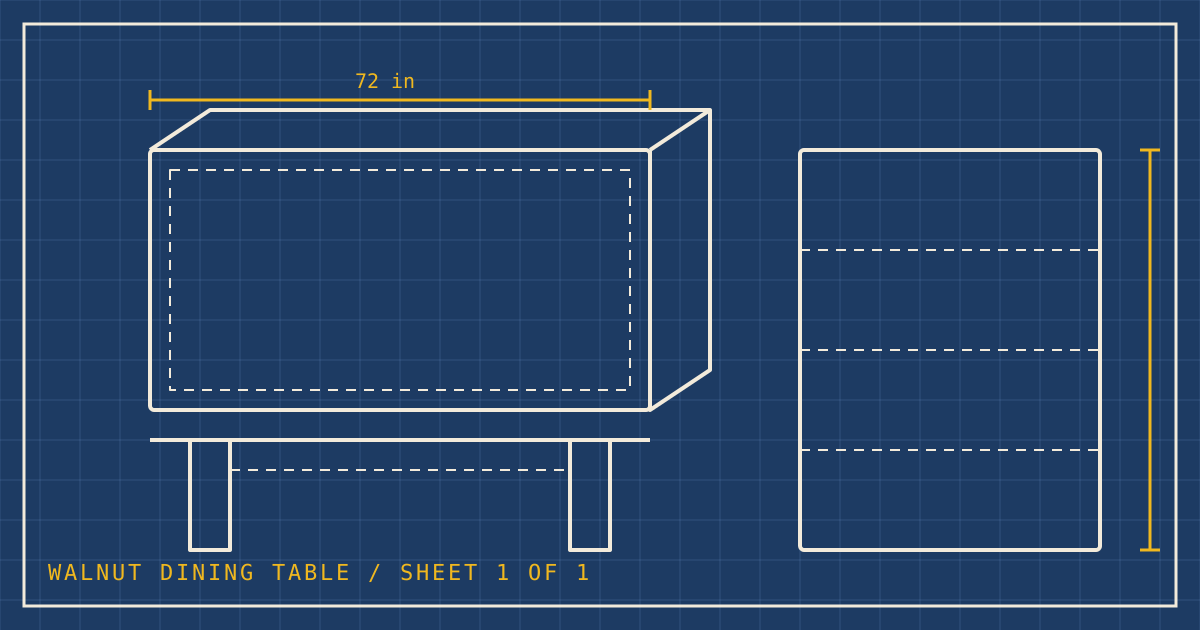
The plan was a 72 by 38 inch top on a trestle-style base, with the legs joined to the stretcher by through mortise and tenon joints. No screws visible, no brackets, nothing a future owner would have to guess about.
| Part | Qty | Finished size | Notes |
|---|---|---|---|
| Top boards | 5 | 72 x 7.6 x 1.25 in | Book-matched where the grain allowed |
| Legs | 2 | 28 x 4 x 3 in | Mortised for the stretcher |
| Stretcher | 1 | 48 x 4 x 2 in | Through tenons, wedged |
| Breadboard ends | 2 | 38 x 3 x 1.25 in | Allow for seasonal movement |
Milling is the unglamorous part that decides everything
Rough lumber is honest. It cups, twists, and hides surprises. I let the boards sit in the garage for two weeks, then milled them in stages: joint one face, joint one edge, plane to thickness, rip to width. Between each stage I stacked and stickered the boards and let them settle.
That patience paid off at glue-up. Boards that had been flattened gradually met each other with no gaps, and I needed far fewer clamps than I feared.
Wood moves, so design for it
The single most useful lesson of the build was seasonal movement. A solid wood top will swell and shrink across the grain through the year. If you pin it down rigidly, it will crack. The breadboard ends are attached with a center tenon glued and the outer ones left free in elongated holes, so the top can move while staying flat.
Good joinery is a constraint you design on purpose. Bad joinery is a constraint the material enforces later.
I think about platform guardrails the same way. A rule that fights how people actually work will get cracked and worked around. A rule that leaves room for the natural movement of the system holds for years.
Finish
I used three coats of a hardwax oil, sanding lightly between coats. Walnut does most of the work on its own, so I wanted the finish to disappear and let the grain speak.
What I would do differently
- Buy an extra board. I used every usable inch and had no room to recover from one bad cut.
- Dry-fit the base twice, not once. A mortise that is a hair off is a much bigger problem after glue.
- Photograph each stage. I have almost no in-progress pictures, and I regret it.
The table has been in daily use for a few months now. Dinner is louder and the table is just big enough, which is the best review a table can get.