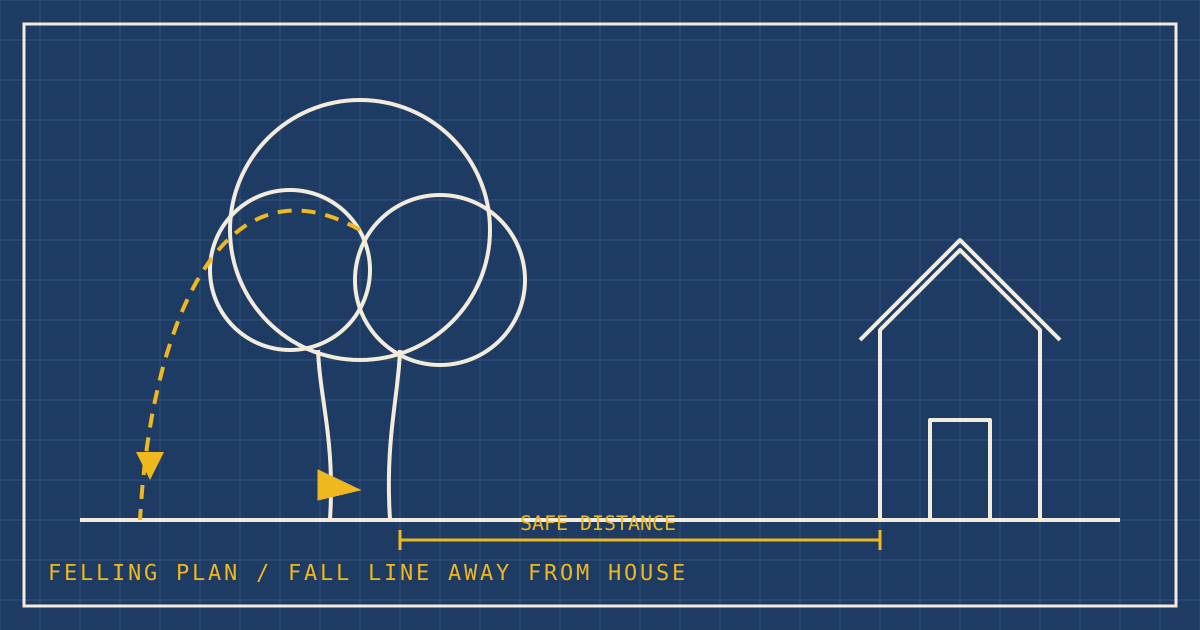
There was an oak next to our house that I had been worrying about for two summers. One large limb hung over the roofline, the trunk had a split near the base, and every storm warning sent me out to the yard to look up at it. This fall I decided it was time.
The plan is the project
I treated it like an incident runbook. Before touching a saw I wrote down the goal (the tree lands in the open lawn, away from the house), the hazards (the roofline, the fence, the neighbor's shed), the escape routes, and the abort criteria.
- Read the tree. Lean, weight of the crown, the split at the base, and any dead limbs ("widowmakers") overhead.
- Pick the fall line. The open lawn, roughly 30 degrees off the natural lean, so I would need to steer the tree rather than just let it go.
- Clear two escape paths. Each at about 45 degrees back from the fall line, free of tripping hazards, and walked in advance.
- Check the weather. No wind forecast, no rain. Wind can undo a good plan in a second.
The cuts
A directional felling cut comes in three parts. The notch (or face cut) sets the direction. The back cut releases the tree. The hinge, the strip of wood left between them, controls the fall.
- I cut the notch to about a fifth of the trunk diameter, with a clean, flat bottom pointing at the fall line.
- I made the back cut slightly above the notch bottom, leaving a hinge that was uniform in thickness.
- I drove in a wedge once the back cut had enough depth to hold it, and had my helper pull a rope line to steer the crown.
The hinge does the steering. If you cut through it, you have given up control of the tree.
On the ground
The oak came down exactly along the line I had drawn, and landed in the lawn with room to spare. It was strangely quiet afterward. My helper and I stood there for a moment before either of us said anything.
The trunk had a larger area of decay at the base than I had guessed. That confirmed the decision to take it down, and also reminded me how much a tree hides from the outside.
The good part
The best part of felling a tree is what it becomes. Some of the trunk is now in the garage on stickers, drying slowly for future projects. The rest became firewood, which is probably the most honest use of any oak limb.
I took one lesson back to the office: the most important work happens before the first cut. A good plan with explicit abort criteria is worth more than skill with the tool.