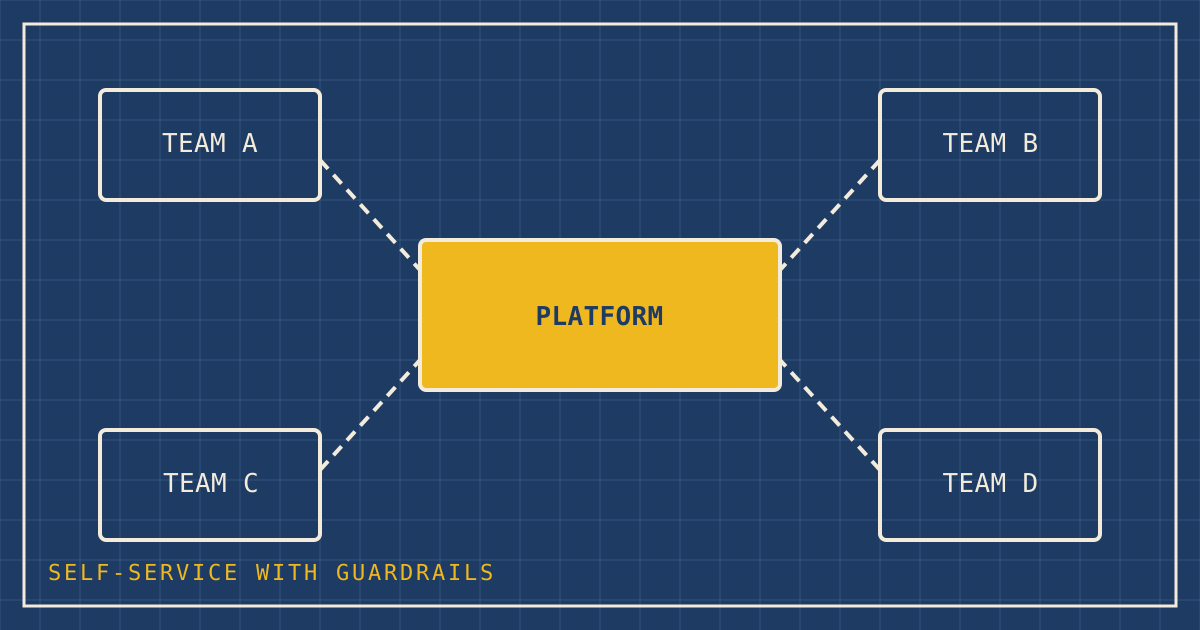
I used to run a platform team that behaved like a help desk. Developers filed a ticket, we wrote or edited a Terraform module, and a few days later their environment appeared. It worked, in the sense that everything eventually got built. It also made my team the slowest part of every project.
The problem was not the code
The infrastructure code was fine. The problem was that only a few people could read it, and none of the developers could see the whole system. A misplaced bracket in a large module once caused an outage, and the post-mortem made the real issue obvious: we had optimized for execution and ignored understanding.
What Meshery changed
Meshery is now core to the platform I engineer at work. It gave us three things we did not have before.
- A shared model. Components, relationships, and designs give everyone, from a new hire to a staff engineer, the same picture of how services connect.
- Guardrails that are enforced, not documented. Instead of a wiki page of rules, the platform checks designs against organizational policy as they are composed.
- Self-service with feedback. A developer composes an environment visually and sees immediately whether it fits the rules, without waiting for review.
What it did for the teams
The effect on my own team was as important as the effect on developers. We stopped being the gatekeepers and became the people who design the road.
- Provisioning time dropped from about four days to about fifteen minutes.
- More than 200 developers can now compose and provision their own environments.
- My team of eight spends its time improving the platform instead of answering the same tickets.
- Onboarding is faster, because a picture of the system is easier to learn than a repository of modules.
When the platform is a product, the best sign of success is the ticket nobody had to file.
Pairing it with agents
The same model that helps new engineers also helps AI agents. With mesheryctl-axi, my team and I can ask an agent to inspect connections, read designs, and explain how a system fits together, then decide what to do. It speeds up the work without taking judgment out of it.
What I would tell another platform lead
- Start by making the system visible. People can only own what they can see.
- Move rules from documents into the platform, so they are checked automatically.
- Measure the tickets you stop receiving, not just the features you ship.